
Human Rights Watch
California Simply Refuses to Spend the Money to Prepare Foster Youth for Adulthood
- A youth who is homeless sleeps on concrete outside a homeless shelter.© 2007 Natalie Leimkuhler
- The vast majority of these young people don't have a clue where to start or how to go about it. Within a few years without the intervention of a caring adult, they slide into the abyss of drug addiction, alcoholism and depression. They fill the wards of the county psychiatric units.they are no more prepared now as adults to live in a complex world than they were when they first were taken into the system as children...
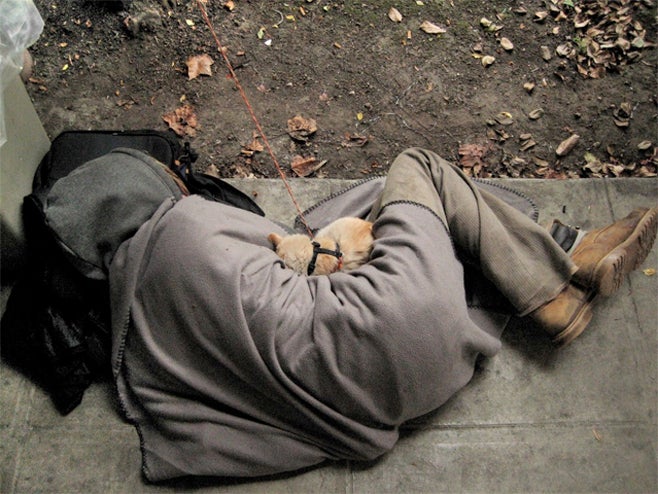
(Los Angeles) - California is creating homeless adults by failing to ensure that youth in foster care are given the support to live independently as adults and by ending state support abruptly at 18, Human Rights Watch said in a report released recently. Human Rights Watch said that the state must provide financial support, connections with mentoring adults, shelter, and other safety nets for young people as they make the transition toward independence. However those services were among the first to go during the Schwartzniger ruination years. The total financial ownness put on the counties who had already made similar cuts.
The 70-page Human Rights Watch report, "My So-Called Emancipation: From Foster Care to Homelessness for California Youth," documents the struggles of foster care youth who become homeless after turning 18, or "aging out" of the state's care, without sufficient preparation or support for adulthood. California's foster care system serves 65,000 children and youth, far more than any other single state. Of the 4,000 who age out of the system each year, research suggests, 20 percent or more become homeless.
"By failing to prepare youth in foster care for adulthood and cutting them off from support abruptly as they become adults, California is failing in its duty to these young people," said Elizabeth Calvin, senior advocate for children's rights at Human Rights Watch and author of the report. "These young people are capable of making the transition successfully, but they cannot do it without the state's help."
This month the state is considering dramatic cuts to child welfare services, which would eliminate an existing transitional living program, over 400 social workers, and other programs for foster youth preparing for adulthood.
"These proposed budget cuts would undermine foster youth's main defense against living on the streets," Calvin said. "The state will bear the costs of the predictable result - increased homelessness."
Most children enter foster care because abuse or neglect at home triggers the duty of the state to step in and protect them. The state becomes their parent and must ensure that children have adequate food, clothing, shelter, health care, and education. But the responsibility to provide the guidance and support necessary for children in foster care to grow into independent adults is no less important, Human Rights Watch said.
Human Rights Watch interviewed 63 young people who became homeless after they left foster care in California. Their stories shed light on the complex array of factors that led to their homelessness: missed opportunities to learn skills, lack of ability to support themselves, a shortage of second chances, and the fact that no one cared what happened to them.
Of those interviewed, 65 percent had not graduated from high school when they were forced out of state care; 90 percent had no source of income. These young people were expected to survive on their own, though the state had provided no real training for adult living skills and was providing no support, financial or otherwise, during the transition. In these cases, homelessness is a predictable outcome.
California state law requires child welfare agencies to develop, in conjunction with each youth in foster care, an "emancipation plan" for what the young adult will do when leaving foster care. A plan that should start at the beginning of high school, and be complete including sources of mentoring and support with the cooperation and help of the foster family. But in practice, plans are most often not made or are unrealistic and unlikely to prevent a youth from becoming homeless, Human Rights Watch said. For those young people who actually had a, "emancipation plan" described to Human Rights Watch plans that lacked arrangements for housing or the income to afford it.
Human Rights Watch called on California to provide foster youth with a variety of options as they make the transition to adulthood, however in past years, those very options were available and then some. Making the transition years more fruitful and more like their peers in family homes enjoy. In the past these could include more time with paid outside services coordinators, extra time at foster home, if needed, before moving out on their own, or helping with arrangements for somewhere to stay during certain periods, such as during college vacations. that is if they were given enough help to get into a college program.
The state should also maintain a spectrum of other options for housing, mentoring, and support for former foster youth, including transitional housing programs, mental health services, services for those with learning disabilities, and services for pregnant and parenting youth, Human Rights Watch said.
"The science of adolescent development shows that childhood does not end abruptly at a certain age," Calvin said. "In most US families, young people continue to receive a spectrum of support - emotional and financial - as they make the transition to adulthood, and the youth in California's care deserve no less. "
Selected Testimony
The day I graduated from high school my foster mom told me, "You've been emancipated. You can't live here anymore." My social worker showed up - I was still in my little graduation dress and heels, my flowers, my cap on. My social worker had never talked with me. [She just] told me, "I've called around and found a shelter for you. You have a bed for four months."
- Karen D., age 21, San Francisco.
On the day of my so-called emancipation, I didn't have a high school diploma, a place to live, a job, nothing...The day I emancipated - it was a happy day for me. But I didn't know what was in store. Now that I'm on the streets, I honestly feel I would have been better off in an abusive home with a father who beat me; at least he would have taught me how to get a job and pay the bills.
- Roberta E., age 24, Los Angeles
"I wish I could have had ... someone to care about me ... like show me how to separate the whites from the darks [for laundry.] I would have hated it at the time, but I wish I'd had that. They never even asked me, ‘Is something wrong? Talk to me."
- Nikki B., age 18, Sacramento
"If you're going to put kids in group homes, in foster care - at least give them what they need to survive and take care of themselves. [When I aged out of care] I was expected to know how to get a job, buy a car, all that stuff, but ... I didn't have any idea how to go about doing things. So, I ended up on the street."
- Tony D., age 20, Berkeley
It is this writer's experience
I will weigh in here. It is been my experience with teenagers and young adults who are homeless at such an early age, 30 – 40% have been recently emancipated from foster care here in California. These are the most unfortunate of the young people emancipated because, without a single exception they did not have a family member to take them in. They were simply dropped off in a different city often because a known family member lived there. Too often that family member had no idea and had little interested in helping. These young people often find each other and form social groups and for protection. The vast majority of these young people don't have a clue where to start or how to go about it. Within a few years without the intervention of a caring adult, they slide into the abyss of drug addiction, prostitution, alcoholism and depression. They fill the wards of the county psychiatric units. They are no more prepared now as adults to live in a complex world than they were when they first were taken into the system as children.
Contact Human Rights Watch for more information on how to help.
